Harvest timing
When Are Carrots Ready to Pick? (The Shoulder Test, and Why Fall Carrots Can Wait)
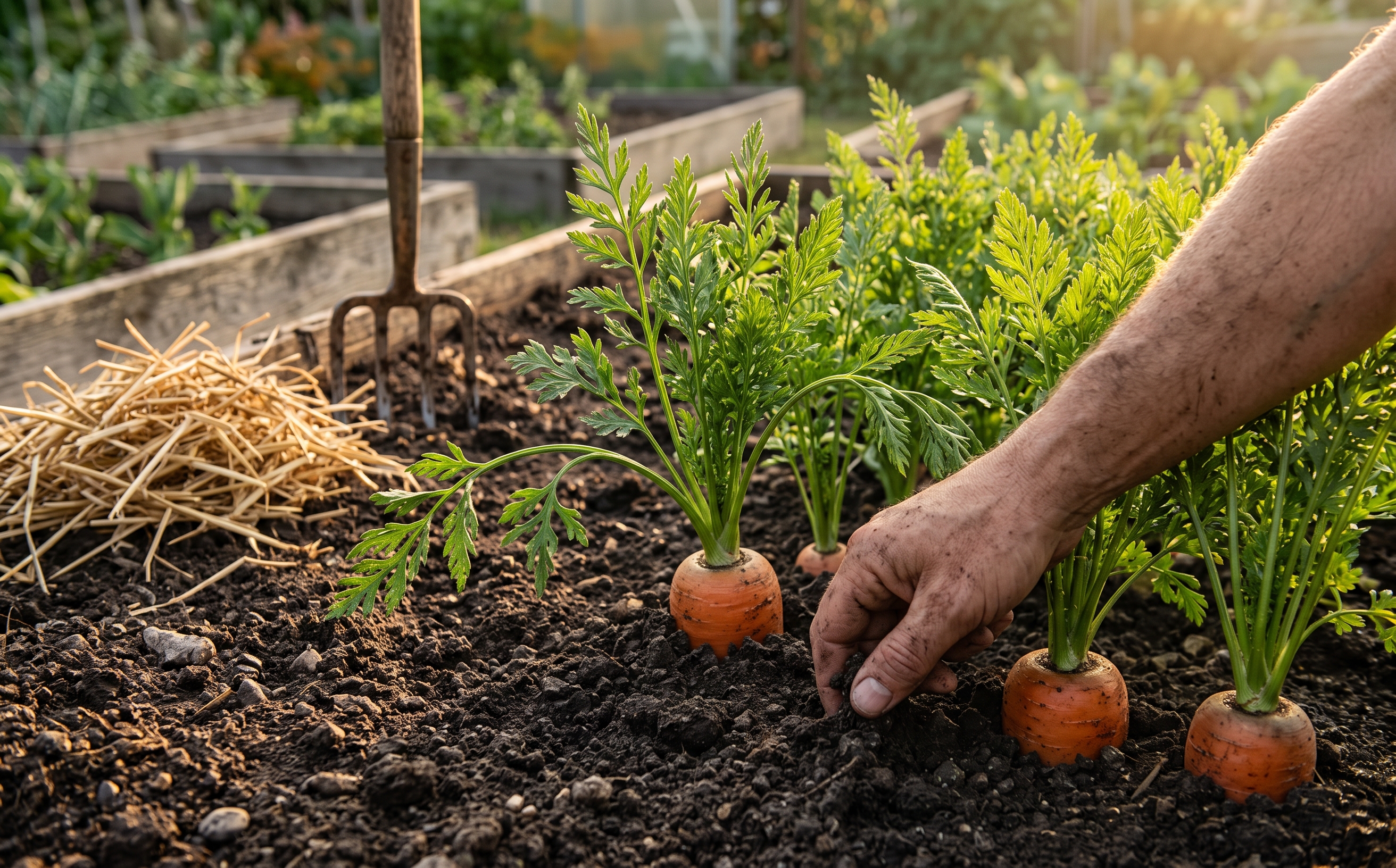
My first fall carrots, I lost my nerve in week eight and pulled the whole row. Forty roots the thickness of a pencil. Half of them snapped off underground because I yanked instead of digging.
The tops had been enormous. That was the entire problem. I was reading the greens, and the greens tell you almost nothing about what is happening underneath them.
How do you know when carrots are ready to pick?
Brush the soil off the top of a root and look at the shoulder. Most garden carrots are ready when that shoulder measures about three quarters of an inch to one inch across, roughly 60 to 70 days after sowing. Leaf colour and top size tell you nothing.
Do it with your fingers, in the middle of the row rather than at the end, because the ends of a row almost always run smaller. Scrape back an inch of soil, feel across the top of the root, then push the soil back over it. An exposed shoulder turns green in the sun and tastes off. Illinois Extension calls that sunburning and says to hill a little loose soil over the row while the roots are swelling, about 40 to 50 days after planting.
Two extension services put the target number slightly differently, and the gap is worth knowing before you go measuring. Illinois says to let most varieties reach at least three quarters of an inch, and calls a carrot over mature at about 1 to 1.5 inches. Maryland Extension says harvest before they exceed 1 inch. Read those together and you get a pick window of roughly three quarters of an inch to an inch, with an inch and a half as the line where the core starts going woody.
Take the biggest roots first and leave the rest in the ground. Carrots in a row never finish together, and every one you lift gives its neighbours room to fatten up.
Download the free Beginner's Gardening Checklist
A simple two-page list of the supplies and seeds a first garden actually needs. Tell me where to send it and it's yours.
Form not loading? Some ad-blockers hide it. Tap here to sign up instead.
Shoulder width, days and size by carrot type
The pick window is about the same for every full-size carrot. What changes by type is how big the root eventually gets, and that is the part beginners guess wrong: a Chantenay at one inch across is nowhere near its full width, and it is still the best it will ever taste.
| Type | Pick it at (shoulder) | Full size for the type | Days from sowing |
|---|---|---|---|
| Nantes | 3/4 to 1 in | 1.5 in across, 6 to 7 in long | 60 to 70 |
| Danvers | 3/4 to 1 in | 2 to 2.5 in across, up to 7 in long | 60 to 70 |
| Chantenay | 3/4 to 1 in | 2 to 2.5 in across, 5 to 6 in long | 60 to 70 |
| Baby / finger | 1/2 in and up | 2 to 3 in long | 50 to 60 |
The full sizes come from Maryland Extension. The days come from Illinois Extension, which gives 60 to 70 for full-size varieties and 50 to 60 for finger carrots; Maryland puts a garden carrot at 65 to 75 days from seed, so treat anything in that whole span as normal. Both count from the day the seed went in, and an autumn sowing will run past the number on the packet, because the days are getting shorter while the root is trying to bulk up.
There is no useful top height on that chart because there is no useful top height, full stop. Maryland notes that Nantes tops are often small and need careful digging, and Illinois warns that carrot tops frequently are not strong enough to pull the root out at all. Loosen the soil with a fork and lift. Grab a handful of greens and pull hard and you will be left holding a bouquet.
If you are choosing types for next spring rather than digging this week, get the sowing right and the harvest takes care of itself. I've ordered from SeedsNow for years; non-GMO and they've never let me down.
When to pull, and when to let the frost do the work
Pull summer-sown carrots as they reach size. Illinois Extension says summer plantings can be left in the ground until a killing frost, but there is no reward for stalling in hot weather: the Old Farmer's Almanac warns that heat turns carrot roots fibrous, which is why spring and early summer crops come out before the weather peaks. Fall-sown carrots are the opposite case. Leave those in and let the cold get at them. The standard explanation for the sweetening is that the root breaks stored starch down into sugars that act as antifreeze in its cells, and whatever the chemistry, a carrot dug in November tastes sweeter than the same carrot dug in August.
Maryland Extension classes carrots as semi-hardy: they withstand light frosts but not heavy frosts or freezing, and the roots tolerate colder temperatures than the tops do. So your greens can look wrecked after a hard night while the carrots below them are fine, and that is also the reason a bare bed has a deadline.
Here is the rough shape of the last safe pull, for carrots with no mulch on them:
Zone 5. First freeze usually lands early to mid October. Lift what you want to store by then, or mulch the rest.
Zone 6. Mid to late October. You often get a run of light frosts first, which is the sweetening you want.
Zone 7. Late October into early November, and in a mild year you can stretch past that.
Treat those as a rough shape and not a schedule. Zone numbers rate how cold your winter gets, not when your first frost arrives, so look up the average first frost date for your own town and work from that instead.
Mulched, the deadline moves a long way. Illinois Extension says a straw mulch over the row lets you harvest until the ground freezes solid, and that in many areas a heavy mulch allows harvest of carrot roots right through the winter. Maryland says the same about fall-planted carrots under straw or shredded leaves, with one condition attached: get the mulch on before the ground freezes. A foot of straw over frozen soil insulates the freeze in.
Quick test: carry a coin out to the row. A US nickel is 0.835 inches across and a quarter is 0.955 inches. If the shoulder is as wide as the nickel, the carrot is worth eating. As wide as the quarter, pick it now. Noticeably wider than the quarter, closer to an inch and a half, you waited too long and the core will be tough.
Common questions about picking carrots
Can you leave carrots in the ground over winter, and do they really get sweeter after frost?
Yes to both, with one condition. The sweetening is real: cold makes the root break stored starch down into sugars that work as antifreeze in its cells, which is why fall carrots beat summer ones on flavour. For the overwintering part, pile a thick blanket of straw or shredded leaves over the row before the ground freezes, deep enough that the soil under it stays soft, then pull the mulch back a section at a time and dig what you need. Illinois Extension says a straw mulch lets you harvest until the ground freezes solid, and that a heavy mulch allows harvest through the winter in many areas. Maryland Extension says the same for fall-planted carrots. The mulch is doing the work, so put it on early.
Why are my carrots so small and thin?
Usually crowding, and it is the most common carrot mistake there is. Carrot seed is tiny and almost everyone sows it too thickly, and Illinois Extension is blunt that twisting and intertwining come from seeding too thickly and inadequate thinning. Thin to one seedling every 1 to 2 inches for full-size types, once the seedlings are about an inch or two tall, and snip them at the soil line with scissors instead of pulling so you do not disturb the roots left behind. The second cause is too much nitrogen. The Old Farmer's Almanac puts it plainly: excess nitrogen promotes top growth rather than root growth, and nitrogen-rich material like manure can make carrots fork, so skip both on a carrot bed. The third cause is simply not enough time. Illinois Extension gives full-size varieties 60 to 70 days and Maryland says 65 to 75, and a late sowing in cooling soil needs longer than either.
How long can mature carrots stay in the ground before they crack or go woody?
In warm soil, think in weeks. Illinois Extension says that once carrots reach harvest size they may be pulled over a 3 to 4 week period, and calls them over mature at about 1 to 1.5 inches across, where an overgrown root develops a tough woody core you have to cut out. Cracking is a separate problem with a separate cause: Maryland Extension pins it on excessive moisture and says to ease off the watering as harvest approaches. In cold soil under mulch, the same carrot holds for months, and that is not a contradiction, because cold soil nearly stops the root growing and growth is what pushes a carrot past its prime. The weeks clock is a warm-soil clock. Once the cold arrives, it stops running.
One thing to do today: go out and uncover the shoulder on three roots in the middle of the row. If they are nickel-wide, you have carrots for dinner and a few more weeks of growing for the rest. Once the beds are clear, what you can still plant in October is shorter than you think, and the same is true in reverse for the August sowing window that got you here. If you like a test you can do with your hands, telling when a watermelon is ripe works the same way.
Want the full beginner's path from bare patch to thriving garden in one place? It's all in my Backyard Garden book for beginners.
Happy growing!
Priscilla
Get the free Beginner's Gardening Checklist
Form not loading? Some ad-blockers hide it. Tap here to sign up instead.
Plus one honest, helpful email a week. No spam, unsubscribe anytime.